


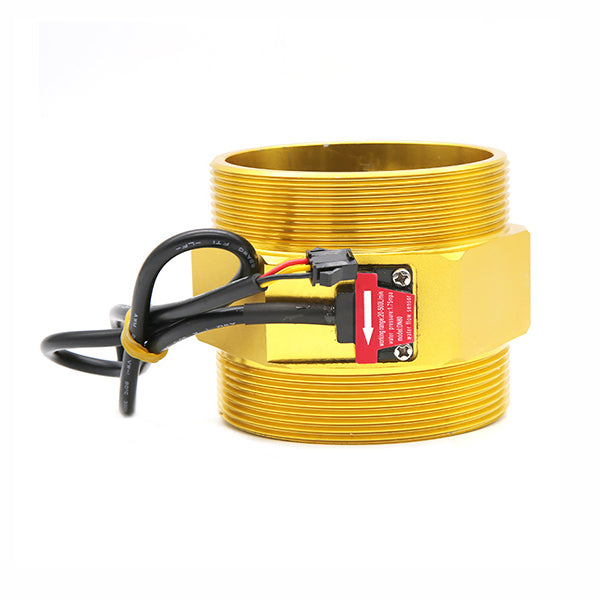
Overview
Feature
TECHNICAL SPECIFICATIONS
Dimension (unit: mm)

Detail

Product FAQ
How does a turbine water flow sensor work?
The sensor utilizes the kinetic energy of the flowing fluid to drive an internal high-precision turbine. As the turbine rotates, a built-in Hall-effect sensor detects the magnetic poles integrated into the blades and converts the rotational speed into a stable square-wave pulse signal. Since the pulse frequency is directly proportional to the flow velocity, the system can achieve precise real-time monitoring of both instantaneous and total flow rates.
What are the water quality requirements for a turbine water flow sensor?
These sensors are specifically designed for clean water and non-corrosive liquids free of solid impurities. To maintain long-term accuracy and prevent mechanical wear, the medium should be free of fibers, abrasive particles, or significant air bubbles. For applications where debris may be present, we recommend installing a 50-mesh or finer strainer upstream to protect the internal turbine assembly.
What should be considered when installing a turbine water flow sensor?
To ensure optimal laminar flow and measurement accuracy, the sensor should ideally be installed horizontally. It is critical to maintain a straight pipe section—typically 10D (10x diameter) upstream and 5D downstream—to eliminate turbulence. Additionally, the unit should be kept away from strong electromagnetic interference (such as large motors or inverters) and severe vibrations to prevent signal distortion or premature bearing wear.