


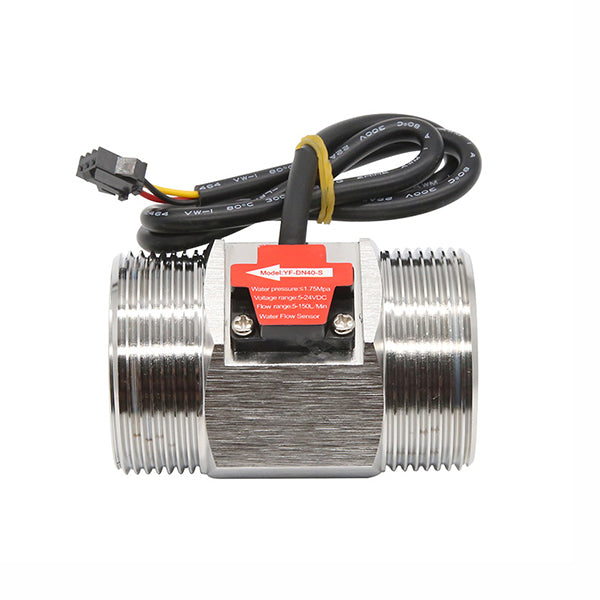
Overview
Feature
TECHNICAL SPECIFICATIONS
Dimension (unit: mm)

Detail

Product FAQ
What media is this stainless steel flow sensor compatible with?
Constructed with a high-grade SUS304 stainless steel body and a food-grade internal turbine, this sensor offers superior corrosion resistance. It is engineered for clean water, deionized water, and non-corrosive aqueous solutions. Its robust metallic construction also makes it suitable for low-viscosity industrial fluids like diesel or light oils. For applications involving strong acids or high-concentration chemicals, please consult our technical team for specific material compatibility.
Can the sensor handle high-temperature or high-pressure industrial systems?
Yes. Unlike plastic sensors that deform under stress, our stainless steel series is built for rugged performance. It supports a maximum operating pressure of 1.75 MPa (approx. 250 PSI) and can safely handle medium temperatures up to 100°C (212°F). This makes it the preferred choice for industrial hot water circulation, pressurized cooling loops, and high-volume pump monitoring where structural integrity is critical.
What are the critical installation requirements for DN40/DN50 sensors?
To ensure a measurement accuracy of ±5%, follow these three professional guidelines:
Flow Direction: Align the fluid flow with the arrow engraved on the stainless steel body.
Straight Pipe Section: For the most stable readings, maintain a straight pipe run of at least 10× diameter (10D) upstream and 5× diameter (5D) downstream to eliminate turbulence.
Positioning: Ensure the sensor is installed at a low point in the piping to keep the internal chamber completely filled with liquid, avoiding air pockets that can cause pulse signal jitter.
Flow Direction: Align the fluid flow with the arrow engraved on the stainless steel body.
Straight Pipe Section: For the most stable readings, maintain a straight pipe run of at least 10× diameter (10D) upstream and 5× diameter (5D) downstream to eliminate turbulence.
Positioning: Ensure the sensor is installed at a low point in the piping to keep the internal chamber completely filled with liquid, avoiding air pockets that can cause pulse signal jitter.