


Overview
Feature
| TECHNICAL SPECIFICATIONS | ||||||||
|---|---|---|---|---|---|---|---|---|
| Material | PC + ABS | |||||||
| MHumidity measurement range | 0~100% | |||||||
| Temperature measurement range | -20~60℃ (-4~140°F) | |||||||
| Power Supply | 2 × AAA batteries (not included) | |||||||
| Function | Measures soil moisture and ambient temperature | |||||||
| Certifications | FCC ID / CE RED / RoHS / IP44 | |||||||
| Product Features | Displays soil temperature and humidity via mobile app; indicator light turns on when humidity < 40% or < 3% | |||||||
| Application Scenarios | Indoor potted plants, green plants, bonsai, and houseplants | |||||||
| Package Size & Weight | 35*23*168 mm, 50 g | |||||||
Application

Fruit Farm

Smart agriculture

Floriculture
Product FAQ
What makes the CUCIR-SPH037 the best wireless soil sensor for smart plant care?
The CUCIR-SPH037 combines professional-grade sensing technology with consumer-friendly wireless convenience. As a premium 2-in-1 wireless Bluetooth soil moisture meter and thermometer, it tracks both soil temperature and moisture levels simultaneously. Unlike traditional analog meters, this smart plant monitor syncs real-time environmental data directly to your smartphone app via a stable Bluetooth connection, allowing you to eliminate overwatering and optimize plant growth with scientific precision.
How far is the wireless range of this Bluetooth soil moisture meter?
Designed for both indoor gardens and outdoor landscaping, this wireless soil moisture sensor utilizes low-energy Bluetooth technology to provide a reliable connection within a standard range of up to 10-15 meters (depending on obstacles). You can easily check your soil's health data from your phone without stepping into the garden plot. For long-term data collection, the device continuously records historical data curves within the app so you can monitor your soil conditions over weeks or months.
How do I properly maintain the moisture probe to ensure accurate readings?
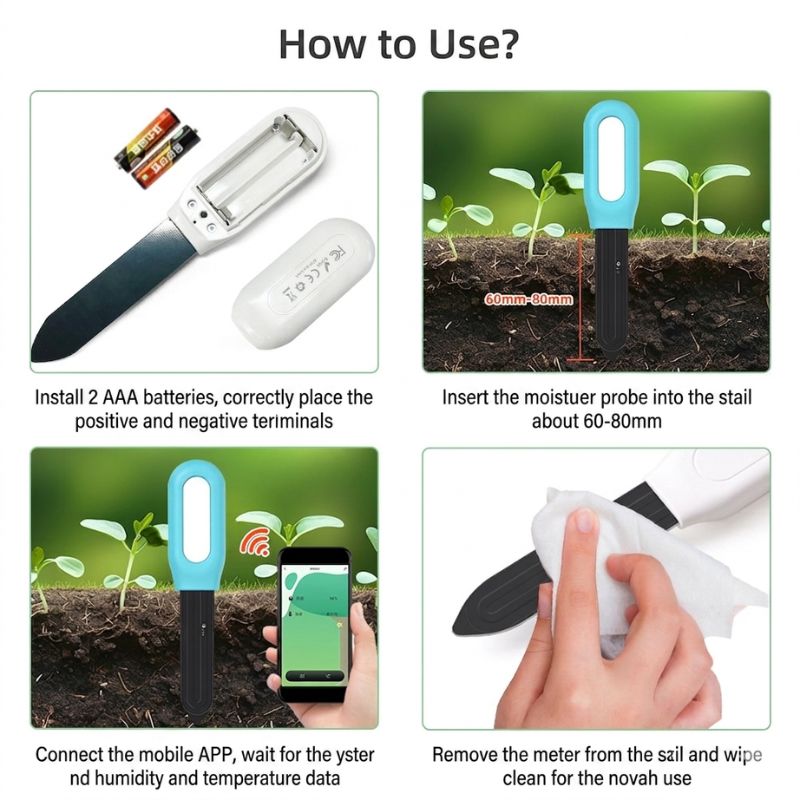
Always insert the moisture probe vertically into the soil to a depth of about 60-80mm for optimal contact.
Avoid Hard Objects: Do not force the probe into extremely hard soil or strike rocks, as this may scratch the sensitive sensor tip.
Cleaning: After each test, gently remove the meter from the soil and wipe it clean with a soft, dry cloth before next use. Never submerge the top housing directly in water.
Avoid Hard Objects: Do not force the probe into extremely hard soil or strike rocks, as this may scratch the sensitive sensor tip.
Cleaning: After each test, gently remove the meter from the soil and wipe it clean with a soft, dry cloth before next use. Never submerge the top housing directly in water.